Wednesday, March 18, 2009
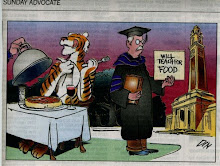
As the Advocate says... LET THE SUN SHINE IN.
Friday, February 27, 2009
University Sustainability Tip #3- There is No Visibility Through Fogged Glass: An Argument Against Partial and Superficial Transparency
The ability to perceive through observation is innately human. We seek to satiate our desires to know and understand through investigating firsthand things that interest and matter to us.
Money undeniably satisfies both of those requirements. And as a price for living in a civilized society, we pay a sizeable chunk of our earnings in taxes (that are too high and too tediously complex, but I digress…). And because we contribute to the creation and maintenance of government projects, we should enjoy the right to examine how those dollars are being spent. When taxes are hardly voluntary (unless you are a crafty politician), should compulsory fees we pay to the government be spent by politicians and bureaucrats without any accountability?
Interestingly enough, LSU System President John Lombardi appeared all too eager to disclose the system’s expenditures on the aforementioned LaTRAC website. Unfortunately for taxpayers, many of us, when delving into each budgetary component’s intricacies, were met with three dirty words: “SUMMARY DATA ONLY.” This phrase signifies the budgetary roadblock of an inability to further investigate a spending category’s specifics.
Sure, Lombardi had no problem telling Louisiana taxpayers that he spent XXXXX on teachers’ salaries. However, disclosing each employee’s salary is left up to the scoop-seeking DAILY REVEILLE and THE TIMES PICAYUNE. And Lombardi had no problem releasing the figures for the egregious $1.8 million in teachers’ conference fees. We just have no idea where these conferences were, which teachers went, how much each cost and what these conferences entailed. Heck, if I were a professor traveling to Greece for a three-day conference and the University footed the bill for an eight-day tropical vay-cay, I would be a little hesitant, as well.
While this problem can be found all over state agencies’ budgets posted online, it is particularly interesting that higher education gazes upon its budget cut fates with tear-filled eyes of desperation, with little or no attempts to meet Louisiana taxpayers halfway.
And how does higher education remedy this dilemma? While financial records can be public records requested and the government (Freedom of Information Act, or FOIA), government hardly expects ordinary citizens to request receipts from public sector purchases. This is why it is owed to the taxpayers of Louisiana that higher education provides every transaction, down to every last penny, in an online, searchable database. As mentioned in previous postings, the infrastructure is already in place and there is no excuse for refusing to comply with this appeal.
It’s time for the bureaucrats of Louisiana higher education to turn on the defogger for the collective windshield of the taxpayers. We’d really like to see what’s on the other side. And as mentioned before, if they are as noble and upright as they claim to be, it is my belief that Louisianians will support their fight for continued funding. We all know that a strong higher education system means a strong Louisiana. And for those who aren’t entirely convinced, this might just do the trick.
Just as a good report card means a trip to Celebration Station for a round of putt-putt for an eight-year-old, a chance at proving their responsibility can garner rewards greater than they could have imagined. But just as a third grader can’t run to his parents and claim he has a 4.0 without proving it with a stellar report card, the university should not reap the benefits without proof of its responsibility expressed with a fiscal report card.
Certainly, higher education wants to renew a public confidence that has long diminished through countless years of waste and mismanagement. And I can’t think of a better opportunity than now.
Friday, February 13, 2009
Governor Jindal outlines six fiscal reforms (WAFB report)
BATON ROUGE, LA (WAFB) - As Louisiana legislators work to balance the budget, there's talk of closing or merging some of the state's four year colleges.
Chairman of the senate finance committee, Senator Mike Michot, says the state's community and technical college system is asking for $200 million to build new schools across the state. But he says higher education is already on the budget chopping block.
"We need to take the approach that everything is on the table," says Jindal. His slogan: It's a new day in Louisiana. And it may just ring true, saving health care and education from cashing out."
"Let's look at shutting down some of our smaller four year institutions," suggests Senator Michot, "and converting those to community colleges."
The senator says the state cannot continue asking taxpayers to foot the bill for 17 four-year schools, countless community colleges and techinical schools, especially after the community and technical schools have asked for $200 million to expand.
Jindal say his six-point plan would find savings in all areas, making government more transparent and accountable to taxpayers, eliminating money that is potentially wasted.
"One of savings DHH implemented," Governor Jindal explains, "eliminated travel funds in their budget for an advisory council that doesn't exist anymore."
Right now if the state faces a deficit, certain funds can only be cut by five percent every two years. Jindal wants that changed to 10 percent every year.
"If we had the ability to cut 10 percent every year," Jindal says, "we could've reduced up to $338 million in mid-year reductions."
Jindal says every year school districts ask for money to help at-risk, poor, and gifted students, but the state never knows how the money helps.
His reform would require schools to report how the funds are used, making the information available on the internet.
The legislature has to vote on the reforms before anything is changed.
As far as the stimulus package is concerned, Jindal says they'll look at how those dollars will help the state, and see what strings are attached before they decide whether or not to use it in the budget.
Jindal has outlined the following six fiscal reforms:
Increase the annual five percent cap on cutting dedicated budgetary units to ten percent
-Eliminate the two-year limit on dedicated fund reductions
-Enhance dedicated fund accountability
-Enact a four-year sunset for all statutorily created funds
-Ensure that public education spending is accountable, transparent, and targeted to areas that improve student performance
-Create a user-friendly website to post school information for parents and the general public
------------------------------------------------------------------------------------------------
So this appears to address the transparency issue, but is that acceptable at the expense of CLOSING or MERGING some of the state's four year colleges??

Wednesday, February 11, 2009
Proposed Budget Cuts Offer Transparency Incentive for Higher Education
With threats of 30 percent budget cuts looming large for the higher education systems of our state, universities are uniquely poised to garner substantial political leverage by proving to taxpayers that they effectively manage their current finances.
An executive order signed early in Governor Jindal’s administration called for transparency in all financial dealings in each and every agency and department in state government. Unfortunately, these LaTrac reports neglect to completely disclose the transactions of one of the state’s largest entities- public higher education.They offer simple groupings and "summary data," but no individual expenditures.
LaTrac is an exhaustive examination of the intricacies of each department’s budgets and expenditures. Why should the university systems, also funded by those same tax dollars, enjoy exemption from public scrutiny? If anything, the universities should prove to the public that they are behaving as good stewards of public money and most importantly, keeping focused on educating.
If the university systems continue to claim that they have managed their funds correctly, why would they resist publishing their ledgers in a dynamic, searchable format? The technological infrastructure is already in place. All they need is the will.
Because the university systems in Louisiana will unlikely utilize such a good faith measure willingly, the legislature should demand a system of financial transparency initiatives to accompany funding legislation. This is not to say that those in favor of this transparency would fight for it and begrudgingly fund higher education as a trade off, but instead, let this serve as an indicator of the fiscal diet higher education system should employ.
This is necessary due to the fact that universities, with LSU leading the way, consistently spend money like drunken sailors at the ports of call of Office Depot and American Airlines. When the end of the year rolls around, departments send student workers to buy copious amounts of sticky notes or ship off tenured professors to a new exotic location for “research” or a “conference.”
And why does this happen? Simply, department heads worry that if they live within their means during the school year, as they should, they will sustain budget cuts. Students seem to get lost in the midst of the taxpayer-funded plethora of file folders and jet-setting to conferences all over the world. And then they wonder why students vote down a modest $2 fee increase to keep activity accounts afloat or become outraged at the mere mention of tuition increases.
The alarming issue posed by these proposed budget cuts is not that they might happen. It is the fact that higher education in Louisiana is either unable or, most likely, unwilling to trim the fat without spoiling the meat. And despite the public awareness of these nasty spending habits, legislators continually green-light higher education expansion projects with no oversight as to their efficiency or success.
If the universities believe that the governor should tap into our “rainy day” fund to save higher education from a short-term hurdle, they need to prove that they’ve changed their ways. Spending legislation to supplement higher education should be coupled with compulsory financial transparency for all systems in the state of Louisiana to confirm their days of fiscal mismanagement are over.
After all, if they’re as honest as they say they are, they have nothing to lose… and so much money to gain.