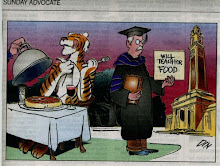
LAFAYETTE — Gov. Bobby Jindal said Wednesday the budgetary blows to higher education and health care would lessen if the state Constitution were changed.
The catch is that such plans, which would have to win two-thirds approval of both houses of the Legislature and a majority of the state’s voters, could not be implemented until the 2010-2011 fiscal year. The plans would not ease the $632 million reduction to colleges and hospitals that Jindal has recommended for the upcoming fiscal year that begins July 1.
“Health care and higher education always take the brunt of budget reductions when our state revenue declines,” Jindal said, noting that people always say such a setup should be changed.
Saturday, April 25, 2009
C.B. Forgotston: Flaw in "Rainy Day Fund"?
I just read where Commissioner of Administration Angele Davis said there was a “design flaw” in the Budget Stabilization Fund (a.k.a. the rainy day fund). (See story here.) As a result there would be little to no net revenues for the upcoming state budget if the leges used $250 Million of the fund.
There is no "design flaw." The fund was intentionally crafted to limit the flow of oil and gas revenues into the State General Fund ("SGF") in hopes that the state would reduce it's dependency on oil and gas revenues.
Alternative solution
If there is no desire to reduce the dependency on oil and gas revenues, there is alternative to refilling the fund.
The $250 Million taken out of the fund could be immediately replaced with $250 Million of the $860 Million 2007-08 surplus (per Const. Article VII, Section 10(D)(2)(d)) and thus all oil and gas revenues would continue to flow into the SGF and would be available for expenditure in the fiscal year that begins July 1.
This process has been used in the recent past to force more oil and gas revenues to flow into the SGF.
This scenario would increase revenues for the Operating Budget by $250 Million. There would, however, be less surplus money to spend on local and NGO capital projects.
If the goal is to forestall cuts to the Higher Education and Heathcare operating budgets this process accomplishes it.
Poor priorities not a flaw
Seems to me the only “design flaw” in the fund is the flaw that has always been in the state budget process -- poor priorities.
The comments from the commissioner begs the question of why are we just now learning of the "design flaw" in a fund that was originally put into the constitution in 1990 and was actually used in 2002? This is not her first time to work for a governor in the Division of Administration.
What am I missing?
C.B.
Thursday, April 23, 2009
Please Listen Gov. Jindal
I was reading a blog article on theoldriverroad.com (The Old River Road) concerning higher education funding and it occurred to me that if so many people have so much to say about the funding of higher education why does it seem like Gov. Jindal is not interested in listening. I know that it is true, he is a busy Governor, traveling around the country to...but his interest in the issue is still unknown. If he was interested enough in cutting funding it seems he would also be interested in finding a solution. I understand that under traditional circumstances Gov. Jindal does not want to use one-time funding to fund reoccurring expenses but are these traditional circumstances? We are in an economic crisis and sometimes we have to do things we wouldn't normally do to make sure that all of Louisiana's Business is taken care of and that includes funding higher education. I only hope he will listen.
Wednesday, April 22, 2009
One Take on Budget Cut Impact
http://www.thenewsstar.com/article/20090421/UPDATES01/90421018
Response to JR Ball's Column in Baton Rouge Business Report
Ball argues that "it's time for officials at LSU, our flagship university, to start answering some tough questions." In the article, found online here, Ball recognizes the "masterful PR job" that LSU has conducted to inform and persuade Louisianians about the "current fiscal nightmare" by submitting "worst-case scenario budget projections." Indeed, Ball captured the sentiments of so many who refuse to lash out against Governor Jindal for his state budget that could cut funding for LSU.
"What LSU officials haven’t done, however, is embrace the concept that the university’s impact must reach beyond the Quad and Tiger Stadium. To be blunt, LSU has been woeful in its efforts to build a knowledge-based economy outside the gates of the campus," he said.
That being said, Ball is not certainly abandoning an understanding of the importance of higher education in Louisiana. "Yes, higher ed [including community and technical colleges] has been woefully underfunded for decades, and, yes, the flagship institution must be considered a bedrock of this state’s future, but it’s also true that LSU must change its thinking," he continued.
When will other leaders and citizen activists also hold the university systems accountable for the current financial state of higher education? It sounds like a failed company, really. Say, for instance, an investor decides to fund an emerging business venture. Then, when the company fails to produce results they promised to said investor, they come back with their hands out and without promises of reform, eager for more dollars. What incentive is there for the investor to continue financing the venture without proof that this company is holding up its end of the bargain? Simply, none.While LSU has made important strides in educating the people of Louisiana, it is important to remember that taxpayers act as investors in the institution of education. We, as taxpayers, invest money into public higher education in hopes of seeing long-term economic stability in our state and consistent improvement in our way of life. And just as an investor would be hesitant to throw more money at a company whose management and leadership refuses to take responsibility for its past failures, it is understandable that taxpayers in Louisiana have their own reservations about throwing money at an institution that has made no promises of thrift, accountability or reform.
Thursday, April 16, 2009
SOS Rally at Delgado TOMORROW
Wednesday, April 15, 2009
Press Conference
Thursday, April 9, 2009
Advocate: Study: LSU’s economic impact big
The study, titled “The Economic Impact of Louisiana State University on the Baton Rouge Metropolitan Statistical Area,” looks at factors such as jobs created, sales generated, residents drawn to the area and research dollars attracted because of the presence of the state’s flagship university.
LSU Chancellor Michael Martin said the study presents a strong case against $219 million in proposed cuts to the state’s higher education. That includes $102 million – about 15 percent of its state funding – from the LSU System and $34 million from the main LSU campus.
There's more
Jindal: La. Constitution change would spread out budget cuts
- By JORDAN BLUM
- Advocate Capitol News Bureau
Saturday, April 4, 2009
Egg the Capitol
Friday, April 3, 2009
College students protest cuts with egg baskets
BATON ROUGE — The dozen baskets of plastic eggs dropped off at the governor's office weren't to celebrate a happy Easter holiday. Instead, the college students that delivered them Friday said it was a form of protest.
The students say the eggs are a symbol of their disappointment with Gov. Bobby Jindal for agreeing to spend $50 million to keep open a chicken plant in north Louisiana while proposing $219 million in cuts to public colleges next year.
The students who delivered the baskets say the governor's priorities are skewed.
Jindal says the state intervened to keep open the Farmerville plant to save 1,300 jobs and 300 chicken farms. The college cuts are part of a series of reductions proposed to balance next year's budget against a hefty drop in state income.
http://www.thenewsstar.com/article/20090403/UPDATES01/90403027